


Section 8 (1) (d) of the Atomic Energy Act, Cap. 154 empowers Council to conduct inspections to assess radiation safety and security conditions and compliance with the Act and the regulations and other requirements specified in an authorisation. The major purpose of conducting regulatory inspections at radiation facilities is to verify the implementation of regulatory requirements in order to ensure the protection of the society and the environment.
These inspections are conducted following a graded approach based on the risk associated with the practice or sources. In this regard, those that pose the highest risk are inspected more often than those that are associated with a lower risk.
The AEC has inspected at least 90% of the registered facilities more than twice. The types of inspections conducted by AEC include;
- Initial/pre-authorization inspection – carried out before the applicant commences work with radiation.
- Planned /Routine inspections – These are usually carried out at specified frequencies depending on the risk associated with the practice and the compliance history of the facility. (c) Reactive inspections are normally carried out to make investigations when the regulatory body deems it necessary or as a result of an invitation from the facility.
(d) Final inspections; inspections carried out following cessation of the authorised practice or if authorisation is otherwise cancelled.
Practices/Activities inspected by AEC
- Medical Practices such as diagnostic radiology, interventional radiology, radiotherapy, and Nuclear Medicine.
- Industrial Practices such as nuclear gauging, well logging, Industrial Radiography, and Industrial Computed Tomography.
- Security Practices for baggage and cargo scanning
d) Agriculture applications e) Education and research in universities
Why the Atomic Energy Council carries out inspections?
AEC conducts inspections to ensure that:
- Design and layout of facilities meet the standards established by Council.
- Rooms housing radiation sources are adequately shielded for the protection of the workers and general public against exposure to ionising radiation.
- Equipment performance meets criteria set by the manufacturer/or Council.
- Policies and procedures for practices are suitable and being implemented.
- The radiation workers are monitored and are availed their individual dose results.
- Persons employed by the operator (including contractors) possess the necessary competence for the effective performance of their duties.
- Any lessons learned are identified and propagated to other operators and suppliers to foster continuous improvement.
Key issues considered during an inspection
Radiation safety inspections target evaluation of the safety of the public, the radiation workers the patients (for medical practices) and the environment as follows;
- i) Public Protection, which is verified by checking:
- Shielding of the radiation premises
- Availability of both administrative and physical security control measures to rooms housing the radiation sources
- Availability of radiation warning systems such as notices, symbols and lights
- Location of the rooms storing the radiation sources
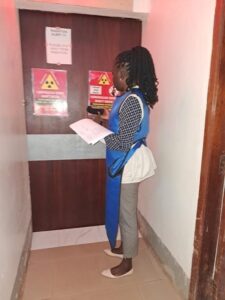
AEC inspector taking radiation survey measurements behind the patient entrance door to the imaging room housing an X-ray machine.
ii) Worker protection is verified by checking;
- Availability of shielded cubicles
- Availability of work procedures and their implementation\
- Availability of personal protective equipment
- Availability of radiation survey and monitoring devices (e) Existence of communication channels within the facility iii) Patient protection (in medical practices) is verified by checking;
- Performance of the medical equipment,
- Availability of;
- Personal protective equipment,
- Policy on pregnant patients,
- Medical request forms,
- Consent to treatment or diagnosis policy or forms for high risk practices e.g.
interventional procedures like fluoroscopy.
- Exposure protocols
- Qualified personnel
- Patient identification procedures
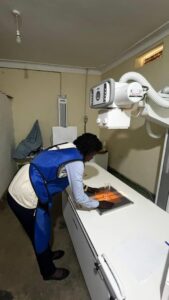
AEC inspector setting up equipment for the collimation and beam alignment test at one of the medical facilities
iv) Environmental protection
Environmental protection is verified by conducting radiation survey measurements to ensure that there is no radiation leakage outside the controlled area and also by checking the waste management measures/plans at the facility.
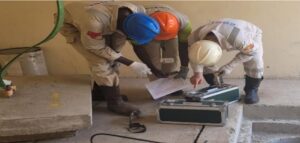
AEC inspector and facility representatives verifying the details of one of the radioactive sources in the storage bunker at one of the facilities
Steps Involved in Regulatory Inspections
a) Preparation
Prior to the inspection, the Atomic Energy Council (AEC) reviews the facility’s documentation including authorization status, previous inspection reports, submitted records on file, and compliance history of the facility. An inspection plan is then developed to guide the inspection activities.
b) Entrance Briefing
The inspection at the facility begins with an entrance meeting between the inspectors and facility representatives. During this meeting, the inspection objectives, scope, methodology, and timeline are explained, and key personnel are identified.
c) Actual Inspection
Inspectors conduct a systematic assessment of the facility’s operations, equipment performance parameters, procedures, records, and radiation safety and security arrangements. Personnel may be interviewed, documents reviewed, radiation survey measurements conducted, observations made and tests conducted on the machine to verify compliance with regulatory requirements and authorization conditions. Additional, requests for information, or enforcement actions may be undertaken where necessary during the inspection.
d) Exit Briefing
At the conclusion of the inspection, inspectors present their preliminary findings to facility management. Areas of compliance, observations, and any identified non-compliances are discussed, and clarification may be sought by the facility where necessary.
e) Follow-Ups
Following an inspection, AEC may conduct a follow up inspection to review the corrective actions proposed or implemented by the facility and verify their effectiveness.
What is expected after the Inspection?
- a) Expectations of the Atomic Energy Council Following the inspection, AEC is expected to:
- Prepare and issue an inspection report outlining the inspection findings, observations, and any identified non-compliances.
- Communicate required corrective actions and timelines for implementation. iii) Review and assess the adequacy of corrective actions submitted by the facility.
- Verify the implementation and effectiveness of corrective actions through document reviews, follow-up inspections, or other regulatory mechanisms.
- Take appropriate enforcement action where non-compliance persists or poses a risk to safety, security, or the environment.
- b) Expectations of the facility management
Following the inspection, the facility management is expected to:
- Review and understand the inspection findings and recommendations in the inspection report.
- Take corrective actions to address identified deficiencies within the specified timelines. iii) Submit evidence of corrective actions and any requested information to AEC. iv) Cooperate with AEC during any follow-up activities or verification inspections.
- Maintain compliance with regulatory requirements and continuously improve radiation safety, security, and operational practices.
- Maintain the inspection report on file as part of record keeping.
Enforcements
AEC takes appropriate enforcement on facilities that do not comply with the applicable radiation protection and safety requirements in the course of their routine operations in accordance with Section 8 (1) (e) of the Atomic Energy Act, Cap. 154, Regulation 11 of the
Atomic Energy Regulations, 2012, and Regulation 12 of the Atomic Energy (Security of Radioactive Materials) Regulations, 2021.
The enforcement actions may take the form of;
- verbal warnings,
- written warnings,
- revocation of authorization,
- Closure or seizure of the radiation source among others as per the AEC enforcement policy.
The major purpose of taking enforcement actions is to ensure compliance of facilities with applicable radiation protection and safety requirements and license conditions, for the safety and protection of society and environment from the dangers of ionizing radiation.
Enforcement actions serve as a deterrent, compelling facilities to follow best practices for radiation safety and environmental protection.
Facilities that do not meet the minimum operational radiation safety and protection requirements of the Atomic Energy Act, Cap. 154 and the Atomic Energy Regulations, 2012 are enforced. Between 2015 – 2025, eight hundred forty-one (841) enforcement actions were taken on radiation sources as indicated below;
Re-opening and un-chaining
After enforcement, facilities are given a timeframe within which they can implement the radiation safety gaps that led to enforcement actions being carried out. Once the facilities address these issues, the enforcement action is lifted for the facility to resume operations.
Advise to the general public regarding radiation safety
The Atomic Energy Council advises members of the public to observe the following radiation safety measures when visiting or interacting with facilities that use ionizing radiation:
- Ensure that the facility possesses a valid authorization or licence issued by Atomic Energy Council.
- Observe and comply with all radiation warning signs, labels, and instructions displayed within the facility.
- Do not enter restricted or controlled areas unless authorized and accompanied by qualified personnel.
- Follow all safety instructions provided by facility personnel and use any protective equipment provided where required.
- Report any damaged radiation warning signs, suspicious activities, or unsafe conditions to facility management or Atomic Energy Council.
- Members of the public should immediately notify the relevant authorities (Police and Atomic Energy Council) if they encounter an abandoned, lost, or suspicious object bearing a radiation warning symbol.
- Pregnant women, children, and other vulnerable individuals should pay particular attention to instructions provided by facility personnel when visiting areas where radiation is used.
- Only qualified and authorized personnel should operate radiation equipment or handle radioactive materials.
- In the event of an emergency, members of the public should remain calm and follow the instructions provided by facility personnel, emergency responders, and competent authorities.