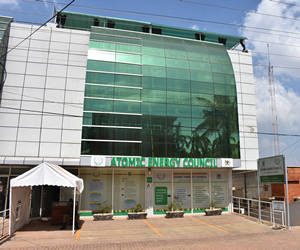




The Government of Uganda has embarked on the development of nuclear energy for electricity generation, research and production of radiopharmaceuticals. This commitment aligns with the aspirations of Uganda Vision 2040, the Energy Policy 2023, and the Fourth National Development Plan (NDP IV). To support this national agenda, the Atomic Energy Council (AEC) is strengthening its regulatory capacity to effectively oversee the safe and secure development of the nuclear installations in compliance with international obligations and national nuclear safety and security requirements. Atomic Energy Council is a government body established under Section 3 of the Atomic Energy Act Cap. 154 with a mandate to regulate the peaceful application of atomic energy, for the protection of the people and the environment from the harmful effects of ionising radiation.
Structure of the Regulatory Framework
The regulatory framework for nuclear installations comprises of a hierarchy of legally binding instruments which include;
a) The Atomic Energy Act Cap. 154
b) Subsidiary legislations (Regulations)
c) Regulatory guides and standards
The Atomic Energy Act Cap. 154 is currently under review to address the missing provisions related to the handling, transport and use of nuclear material and to strengthen the mandate of Atomic Energy Council, among others.
Basis of AEC’s regulatory documents
The regulatory documents developed by AEC are anchored on requirements, standards and guidelines issued by the International Atomic Energy Agency (IAEA) as well as research findings by the International Commission on Radiological Protection (ICRP), the United Nations Scientific Committee on the Effects of Atomic Radiation (UNSCEAR), and other research bodies. Atomic Energy Council also consults experts from regulatory bodies from Countries with experienced nuclear regulatory infrastructures such as the United States Nuclear Regulatory Commission (US NRC), among others. The above international standards provide the fundamental principal criteria for nuclear and radiation safety, nuclear security and nuclear safeguards, including risk criteria and dose limits for both normal operation and potential exposure scenarios, applicable to workers and members of the public.
Key safety principles for nuclear installations
In the regulation of nuclear installations, AEC’s priority is to ensure that the authorised persons/utilities adhere to the following core safety principles as follows:
a) Defense-in-depth (DiD)
b) Radiation protection
c) Proven engineering practices
d) Quality assurance
e) Safety Culture
f) Independent peer reviews
g) Human factors
h) Graded approach
i) Operating experiences and research The above safety principles collectively ensure that risks are managed within acceptable limits and that regulatory decision-making is consistent, transparent, and aligned with the International Safety Standards.
Guiding principles in the development of AEC’s safety criteria
The following principles underpin and form the basis of the AEC’s criteria for ensuring safety: a) Regulatory independence: AEC’s independence is entrenched under Section 12 of the Atomic Energy Act Cap. 154 which ensures that regulatory decisions are made and regulatory enforcement actions taken, without undue pressure and influence from interested parties. The credibility of the AEC is assured through its independence from the facilities it regulates and the promoters of nuclear technology. b) Responsibility for safety: The prime responsibility for safety rest with the person or organization responsible for facilities and activities that give rise to potential nuclear damage. c) Civil liability to nuclear damage: The operator of a nuclear installation is strictly liable for compensation associated with nuclear damage. d) Leadership and management for safety: Effective leadership and management for safety should be established and sustained in organizations concerned with, and facilities and activities that give rise to, potential nuclear damage. e) Radiation protection: Protection of the workers has to be optimized to provide the highest level of radiation protection and nuclear safety that can reasonably be achieved (ALARA). f) Prevention of accidents: The authorised person/utility has to make all practical efforts to prevent and mitigate nuclear or radiation accidents. g) Emergency preparedness and response: The authorised person/utility has to make arrangements for emergency preparedness and response in case of nuclear or radiation incidents. h) Protection of the future and present generations: People and the environment, present and future generation, must be protected against radiation risks. This can be achieved by ensuring that appropriate means are available for long term management of spent nuclear fuel and radioactive waste generated during the life time of the nuclear installation. i) Safety assessment: The utilities/authorised persons must demonstrate effective understanding of the hazards and their control for an action or facility through a comprehensive and systematic process of safety assessment. The safety assessment has to incorporate both deterministic and probabilistic approaches where appropriate. j) Safety policy: The utility or operating organization must anchor nuclear and radiation safety on a well written safety policy in support of a sound safety culture. Nuclear and radiation safety should have an overriding priority in all authorised actions. k) Staffing and competence: Organizations involved in the lifecycle of a nuclear facility or activity must be staffed with competent and sufficient qualified personnel having proper awareness of the technical and administrative requirements for safety.
Strengthening regulatory capacity for nuclear installations
With Uganda advancing towards the construction of a nuclear research reactor and nuclear power plants to catalyze the social and economic transformation, AEC is intensifying efforts to strengthen its capacity through education and training, to provide regulatory oversight. Strengthening the regulatory framework for nuclear installations is a cornerstone of Uganda’s nuclear energy programme. Through the Atomic Energy Council, Uganda is ensuring that the development of nuclear technology proceeds with the highest levels of safety and environmental protection, in line with international best practices and national aspirations for sustainable development.